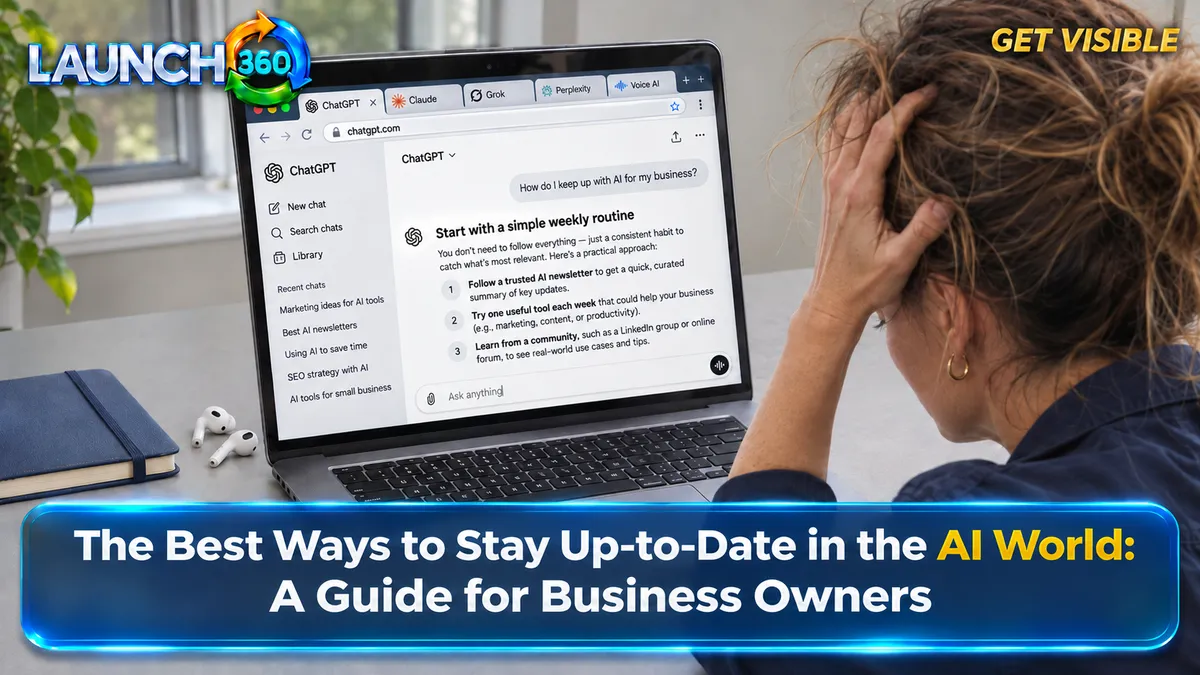
What should you learn about AI first?
Begin with a recurring task your business actually performs: preparing a first draft, organizing public research, summarizing non-sensitive notes, or answering routine service questions. Learn what good output looks like before choosing an automation platform.
Separate general AI concepts from product-specific features. Knowing how to evaluate accuracy, context, and limitations transfers across tools. Memorizing the newest interface does not. Keep a short list of questions you want learning to resolve, such as whether a tool can use approved information or transfer an unresolved inquiry to a person.
Which sources deserve your attention?
Use official release notes and help documentation to confirm what a product currently supports. Use independent reporting to understand context, and practitioner examples to identify ideas worth testing. Treat demonstrations as demonstrations rather than proof that the same result will occur in your business.
Keep the list short enough to use. A source is useful when it distinguishes availability, limitations, and actual evidence from speculation. Check the publication date and whether the feature applies to your account, region, or subscription before planning around it.
How can you build a manageable weekly routine?
Reserve a small, consistent time block. Review changes in the tools you already use, select one development related to an existing problem, and decide whether to ignore it, investigate it, or test it. Keep a separate ideas list so every interesting announcement does not become an urgent project.
A practical learning log
- Business question and current method
- Tool or feature tested and date
- Example input and expected result
- Corrections and review needed
- Decision: adopt, revise, or stop
How should you test a new AI use?
Use a contained task and appropriate sample information. Define success before testing: usable output, acceptable review time, and a clear benefit over the existing process. Include awkward cases, missing information, and questions outside the intended scope.
For customer-facing AI, verify business facts, escalation, contact routing, and what happens when the system is uncertain. Do not assume a convincing response is correct. Keep sensitive business or customer information out of casual experiments and check the service’s data handling and account controls before broader use.
When does learning become an implementation project?
Move forward when the problem is clear, the process is repeatable, and someone can own quality after launch. Consider setup, training, ongoing review, usage costs, and the time needed to maintain the information behind the tool.
Launch360 offers speaking and workshops and consulting to connect learning with practical business decisions. For connected AI and automation, review the current plan scope. Ask for a demonstration based on your actual inquiry or workflow, including the point where a person takes over.
Frequently Asked Questions
How much time should I spend keeping up with AI?
Use a time block you can maintain and tie it to a business question. The goal is a better decision, not consuming the most news.
Should I buy every tool that might save time?
No. Test the need, the actual output, and the total work involved first. Prefer a clear benefit over a larger collection of subscriptions.
Can AI automate my entire business?
AI can support selected tasks, but business judgment, accountability, exceptions, relationships, and quality still need people. Be cautious of claims of complete hands-off operation.
What should I ask before booking AI training?
Ask whether it covers your business uses, hands-on practice, accuracy checks, data handling, and follow-through. Confirm the format and current scope before committing.
Start. Grow. Scale. Amplify.
Turn AI learning into one useful business improvement
Discuss a practical workshop or implementation priority with Launch360. Start with a task, a test, and a clear standard for success.